


SiFive 博客
来自 RISC-V 专家的最新洞察与深度技术解析

CES 2025: The Tech Trends Driving Silicon Design
This was my first time attending CES in (significantly) more than a decade. 141,000 attendees visited 4,500 exhibitors in the too-close-to-the-New-Year event in Las Vegas. As with most tradeshows, there were two levels to my conversations with customers and partners:
- Reviewing the products in the booths that showcased technology available now and available soon.
- The conversations behind the scenes focused on the challenges faced with those products and the desire to solve those issues in next-generation products.
First, the obvious statement – AI was everywhere. All types of products were “AI enabled,” “AI powered,” and “AI infused.” This reminds me of the early phase of the Internet of Things (IoT) wave, when there was an intense focus on rushing connected platforms into the market, without stopping to build out a business plan that included market validation as to whether the connected platform addressed a meaningful problem. I remain unconvinced that an AI mirror, while quirky and fun, actually solves a problem that will drive a sustainable business over time.
One clear exception is the potential of AI in the computing segment. NVIDIA’s Project DIGITS announcement and a slew of other news from the likes of Intel and AMD showed that computers that feature dedicated AI hardware will be a huge topic for 2025. This is a great opportunity for SiFive since: The latest hardware needs to be optimized for performance, power, and area These types of applications have no real ties to legacy software. SiFive offers a range of products for AI workload acceleration, including our Intelligence XM Series.
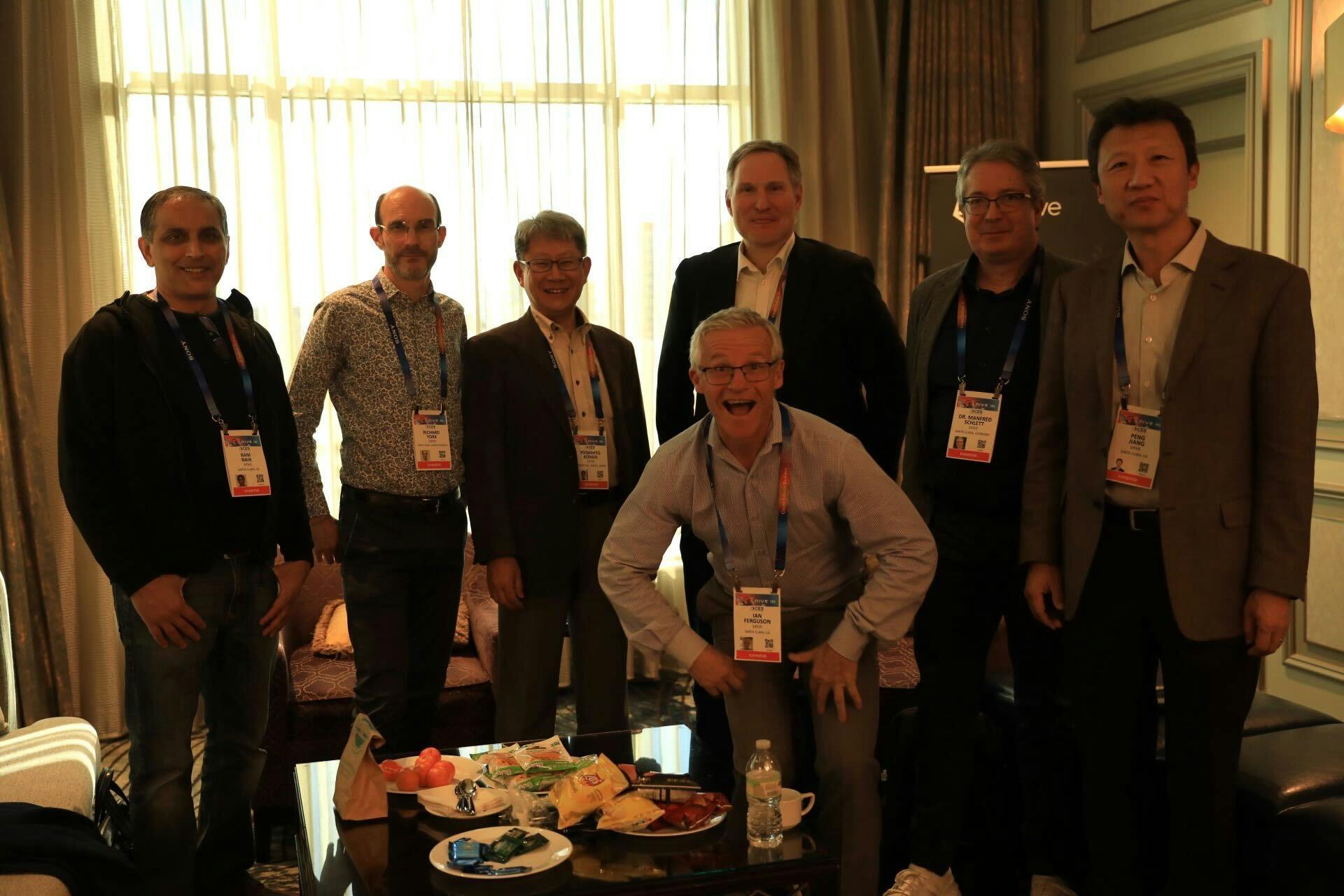 Here is a snapshot from CES of me and of my amazing colleagues at SiFive
Below are some other key takeaways from this year’s show:
-
Wearables: Companies showcased a diverse set of wearables, including a range of products that targeted different aspects of healthcare, such as quality of sleep. The conversations about the requirements for the next generation systems centered heavily on energy efficiency as companies have incorporated more capabilities into their devices and must maintain or improve battery life. Two of the biggest challenges to maintain or improve battery life include efficiently moving data to/from memory and determining how/when/if to connect to the cloud. I heard a lot of discussions about different types of energy harvesting and architectures that shifted all or some of the processing into memory to make dramatic improvements in energy conservation. Additionally, there were a number of paper-based batteries on display as a more sustainable alternative compared to traditional lithium-ion batteries.
-
Automotive: The majority of the automotive industry seems to have pulled back on Level 5 and Level 4 autonomy, except for specific well-controlled environments. Instead, many companies are looking at practical ADAS functionality to support a driver as opposed to replacing one. In this area, there were three main conversations:
-
Secure delivery of new functionality; As Rivian said, with the exception of an interior light, every subsystem in a deployed vehicle needs to be updatable. The challenge is to do that in a way that doesn’t compromise the safety and security of the vehicle.
-
Supply chain resiliency: Unlike the consumer segment, automotive products are expected to be viable for decades. Many fear that 2025 will be a year of industry consolidation. This need for longevity, combined with ongoing geopolitical activities and other seismic events like litigation and pricing changes in the chip industry, is creating serious cause for concern. This is one of the strongest commercial value propositions that RISC-V offers. RISC-V is driven by collaboration around an open standard and it will be around for decades to come.
Faster development, less of everything else! (Weight, cost, size of electronics, etc): I’ve visited China multiple times over the past decade and one of the most staggering changes has been the domestic automotive industry. Non-household names in the U.S, like BYD Auto, Chery, Geely Auto, Great Wall Motor, and NIO, have displaced the traditional overseas brands and are planning to expand into new geographies. With the path to accelerate (and be more nimble) during product development, companies are shifting to a software-defined mindset. To support software-defined vehicles (and to achieve the “less” described above), the underlying system architecture is undergoing a radical change toward fewer, very performant computing platforms. This shift needs a processor architecture like RISC-V that can span the range from MCUs to HPC components with the same instruction set. SiFive sees significant growth in this segment as we help automakers deliver safe and secure products for connected vehicles.
Embedded: While a lot of attention goes to the main (“applications”) processor in a laptop, TV, or smartphone, the reality is that these products include multiple processing elements. While the typical vector for the applications processor is around performance, increasingly these will incorporate different mixes of CPUs, GPGPUs, and NPUs since different workloads run optimally on different processor types. During CES, we heard loud and clear that: Additional processors are much more sensitive to cost and power. These include processors for applications like touchscreen controllers, storage, communications processors, and industrial sensors.
Incumbent suppliers have shifted their product roadmaps away from the needs of these processors, focusing instead on other use cases.
SiFive is helping a wide range of companies deliver AI infused capabilities into these small MCUs while meeting extremely tight power and cost targets. This underserved market represents a huge opportunity for SiFive and, indeed, the broader RISC-V community.
The next industry event that SiFive is planning to attend is Embedded World in mid-March. We will be showcasing our broad RISC-V IP portfolio and how it aligns to the above areas. We look forward to seeing you there!

Ian Ferguson
Ian Ferguson is the Vice President of Vertical Markets and Business Development at SiFive, where he is responsible for accelerating growth of the company across a range of growth segments including datacenter, consumer and automotive market segments. Of particular focus is how artificial intelligence offers an opportunity for industries to shift from incumbent architectures to the RISC-V open standard.
Prior to joining SiFive Ian worked at Lynx Software Technologies as the vice president of marketing at Lynx Software Technologies, responsible for all aspects of the outward-facing presence of the company to its customer, partner, press and analyst communities. Ian was a key part of the team that was responsible for selling the company to OceanSound Partners, a private equity firm. Ian also spent nearly 11 years at Arm, where he held various roles leading teams in vertical marketing, corporate marketing and strategic alliances. Ian is a graduate of Loughborough University (UK) with a bachelor’s degree in electrical and electrical engineering.


Read more Insights from the RISC-V Experts

SiFive 视角:RISC-V SPMP 规范正式批准,助力嵌入式安全飞跃发展

为您介绍 SKL:SiFive 算子库
