


SiFive 博客
来自 RISC-V 专家的最新洞察与深度技术解析

SiFive Leadership in the Rapidly-Growing Embedded Market
In June 2024, SiFive announced the 4th generation of its Essential Product line. Products from the Essential family are already deployed in billions of consumer and IoT products including smartphones, sensors, SSDs, FPGA platforms, surveillance cameras, smartwatches and more. This new release contains a wide range of iterations on the previous generations and numerous new features. The inspiration for the majority of these enhancements came from customer feedback. One specific example is the support for AMBA ACE, a protocol for bidirectional data coherency that enables customers to create systems with multiple clusters of Essential processors.
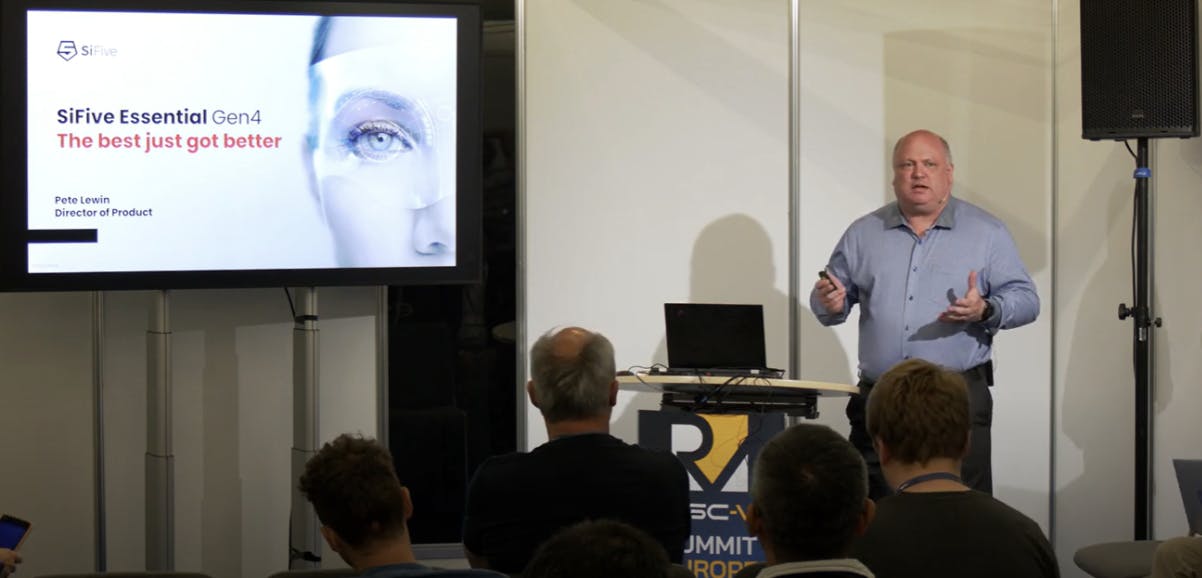
What do customers cite as important aspects when they are selecting a processor? Well of course, power, performance, and area (PPA) are always important. Power efficiency is particularly important to applications such as smart sensors as they often need to run for years on a watch battery or very small solar cell. Additionally, there is often a particular focus on code density since memory size directly impacts system cost. There are also some concerns around security. As embedded systems become increasingly connected, and capabilities such as the ability to update firmware over the air, a whole new range of potential attack vectors need to be addressed. The new generation of Essential products improves on all these areas, with new code density extensions, advanced power management options, and the WorldGuard security architecture. You can check out this video from the RISC-V Summit in Munich in June 2024 for some additional details.
Quantifying performance is never straightforward. Clock frequency is one factor, but it’s far from the only one. To estimate real world performance, we run a range of benchmarks. Despite its well known limitations, the starting point is still often the Dhrystone benchmark due to its ubiquitous nature. The next level is often EEMBC benchmarks specific to the market segment. However, many customers know exactly what code they are going to run, and have some representative code from previous products. In this case, we have a range of simulation environments and FPGA platforms so customers can perform evaluations.
One of the big challenges I face as a product manager is assessing the feature requests from existing customers and prospects. What I have found useful over the years is to:
Look for common themes. Try to look beyond the specific feature request and understand the “why” behind the request. What is the customer trying to achieve? This is important as there might be a more effective way to achieve the same objective.
Then it's a case of balancing engineering resources and timescales against other projects and making difficult tradeoffs… set against a backdrop of understanding specific markets and the competitive landscape.
Since our Essential Series offers a lot of flexibility, our customers can choose whether to use the Essential processor as a microcontroller in its own right, where it's the main processor in the system, or use it as a core alongside a different CPU. In the latter case, how it integrates with the rest of the system becomes a very important factor. Essential CPUs offer a wide range of interface options to give our customers more flexibility to suit their specific application needs.
To give a couple of examples about applications where some readers might not even think a processor would exist:
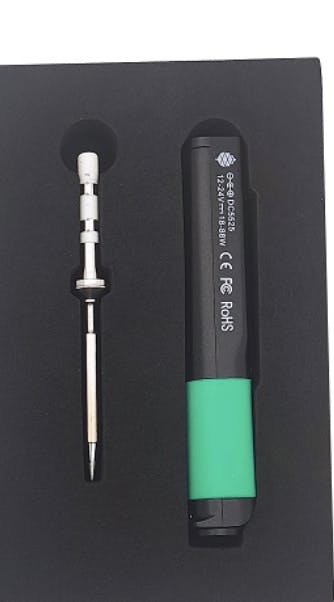
- Managing temperature in a soldering iron.
- In SSD controllers, performing “wear leveling” (working out where to store new files to ensure that the flash inside the system isn’t worn out too quickly) and implementing encryption on the storage device.
To address these and thousands of oher different applications and use cases, the Essential family covers quite a range of performance points, from a two stage pipeline up to dual issue, eight stage pipeline. SiFive has been focusing on the automotive market segment as well and this segment clearly has a lot of requirements around functional safety, and isolating certain system elements from each other. The automotive market has a reputation of being extremely slow moving. In part, this is driven by the obvious need to be focused on safety and quality, but it was also due to the somewhat static construction of the value chain and the evolutionary nature with which certain elements changed over time. The rapid adoption of electric vehicles, ADAS, and autonomous driving—along with the arrival of artificial intelligence—is driving significant change.
In today's cars there are now a lot more actuators, a lot more sensors, and with them a lot more signals coming in that need to be processed and passed around the vehicle. Consumers are demanding multiple tablet-sized screens to interact with all this technology. This is causing fundamental changes to car architectures in order to increase reliability while reducing cost, weight, and power. Domain and zonal architectures have appeared to provide substantial improvements to those measures. At the chip level, this is causing a shift to fewer but larger, more powerful, multicore heterogeneous SoCs. These computing elements must be knitted together in a way that avoids compromising the functionality, reliability, and safety of the vehicle. SiFive is committed to providing IP that meets the latest safety and security specifications, as well as delivering features like WorldGuard to segregate memory for specific workloads away from others.
Unlike certain incumbents, SiFive is committed to continuing to evolve its entire processor portfolio to deliver improved PPA and innovative features. To that end, the planning behind the fifth generation of our Essential series is well underway. We see huge new opportunities for SiFive and our customers from growing the capabilities and characteristics of the low and mid-range of our portfolio.
And no technology blog is complete without a mention of AI! While a lot of the recent press around AI has been around large language models running on powerful servers, we have customers today implementing various AI capabilities on the fourth generation of Essential processors. These may be workloads like wake word detection, object detection or fingerprint sensing. Part of the work around defining future generations of the Essential family includes ways to improve the effectiveness of these algorithms to enable the next generation of AI innovation in embedded systems. SiFive Essential products will play an important role in bringing AI to the edge across a wide variety of devices.


Read more Insights from the RISC-V Experts

SiFive 视角:RISC-V SPMP 规范正式批准,助力嵌入式安全飞跃发展

为您介绍 SKL:SiFive 算子库
